
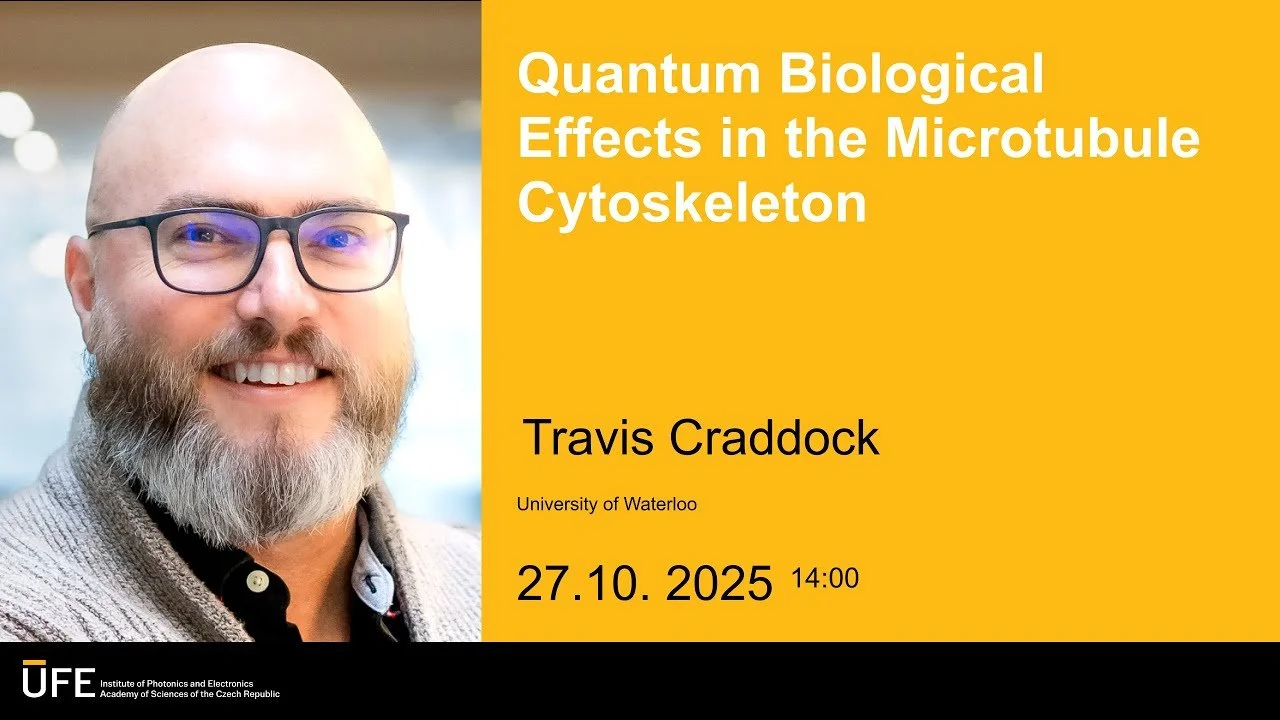
Quantum Biological effects in the microtubule skeleton
In an October 2025 Bioelectrodynamics (BioED) webinar hosted by the Czech Academy of Sciences, Dr. Travis Craddock (University of Waterloo) explored how quantum phenomena may influence biological systems, particularly within the brain. Moving beyond classical models of electrical and chemical signalling, the talk examined the possibility that quantum processes contribute to neuronal function.
Focusing on microtubules, the structural polymers that support neuronal architecture, Dr. Craddock presented theoretical and experimental findings suggesting that chemical interactions can modify energy transfer and optical properties in tubulin proteins. He also discussed evidence consistent with quantum spin dynamics, including a potential role for magnesium-25 nuclear spin, pointing toward a direct connection between quantum physics and cytoskeletal function.
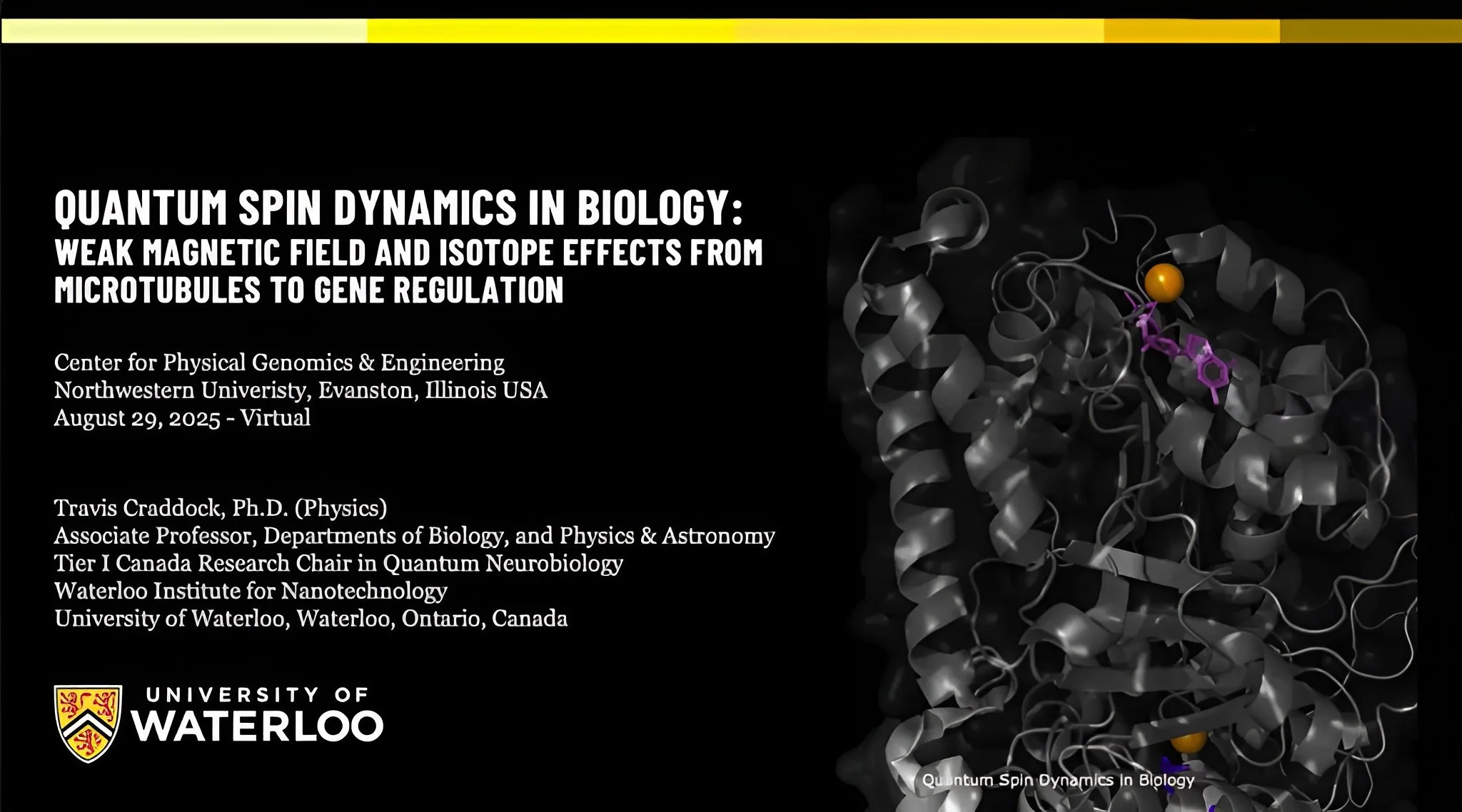
Quantum Spin Dynamics in Biology
At Northwestern University’s Monthly Seminar in Physical Genomics (August 2025), Dr. Travis Craddock (University of Waterloo) examined how weak magnetic fields and magnetic isotopes may influence biological systems despite their extremely low interaction energies. Drawing on principles of quantum biology, he discussed spin-dependent reaction pathways, particularly the radical pair mechanism, as a framework for understanding these effects.
The talk highlighted theoretical and experimental evidence linking quantum spin dynamics, including the nuclear spin of magnesium-25, to microtubule function and broader cellular processes. Dr. Craddock outlined how such spin-sensitive chemistry could extend to genome regulation, DNA repair, and mitochondrial function, suggesting potential implications for diagnostics and targeted therapies in neurological disease, cancer, and infection.
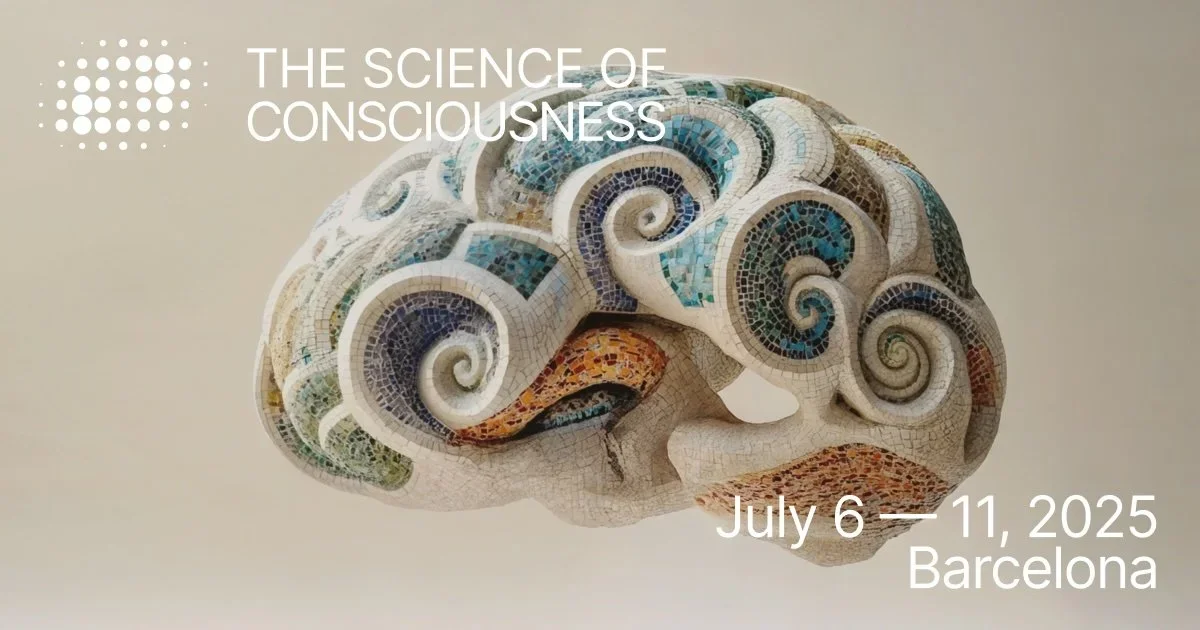
Science of Consciousness 2025 - Quantum Biology Plenary
At the Science of Consciousness Conference 2025 in Barcelona, the Quantum Biology Plenary brought together leading researchers to examine the intersection of physics, biology, and mind. The session featured Philip Kurian, Travis Craddock, and Anita Goel, who addressed topics ranging from the computational capacity of life and magnetic effects in quantum neurobiology to broader questions about whether new physical frameworks are needed to understand living systems and consciousness.
Part of the world’s longest-running interdisciplinary conference on consciousness, the plenary reflected the event’s wide scope, spanning neuroscience, quantum physics, philosophy, AI, and cosmology. The discussion highlighted quantum biology as an emerging lens through which researchers are re-examining cognition, life, and humanity’s place in the universe.
Location & Date: Barcelona, Spain — July 6–11, 2025
Session: PL-10, Quantum Biology and Superradiance
Date: Thursday, July 10Presenters:
Philip Kurian: Computational capacity of life in relation to the universe
Travis Craddock: Magnetic effects in quantum neurobiology
Anita Goel: Does physics need a revolution to understand life, living systems, and consciousness?

What is Quantum Neurobiology and How Can it Help Neuroinflammatory Illness?
At a University of Waterloo Faculty of Science lecture, Dr. Travis Craddock introduced quantum neurobiology and its potential relevance to neuroinflammatory and neurodegenerative illnesses. After a quick primer on key quantum ideas (spin, tunnelling, entanglement), he reviewed evidence that weak magnetic fields and magnetic isotopes can shift biological outcomes, pointing to spin-dependent chemistry (often framed through the radical pair mechanism) as a possible explanation.
He then focused on microtubules, essential cytoskeletal structures in neurons, and how inflammation-linked reactive oxygen species could trigger ultra-weak photon/energy events inside cells. Craddock described modelling and lab measurements suggesting excitation energy can migrate through microtubule aromatic amino acids farther than classical expectations. If confirmed, these pathways could help explain how inflammation translates into cellular damage, and suggest new diagnostic or therapeutic strategies for disorders like Alzheimer’s, Parkinson’s, ALS, and long COVID.